
“Privacy coins make you invisible” is a persistent claim that is both oversimplified and dangerous. A more accurate—and more useful—starting point is this: privacy technologies change the attack surface. They replace some observable signals with harder-to-use or differently structured signals, but they do not eliminate trade-offs between usability, network-level metadata, and human operational security. For a US reader deciding whether to hold, transact, or custody Monero, Haven (XHV) or other privacy-aware assets, the practical questions are: which mechanisms really protect you, where do those mechanisms break, and what does a wallet actually do (and not do) to maintain privacy?
This article corrects common misconceptions about how privacy protocols work, explains how anonymous transaction systems like Monero and Haven function at a mechanism level, and evaluates a multi-currency privacy wallet’s features and limits using Cake Wallet as a running example. The goal is decision-useful: after reading you should have sharper criteria to choose a wallet, a clearer view of network vs. device privacy, and a short checklist you can apply when handling private assets in the US context.
How “anonymous” transactions actually work: mechanisms, not magic
Privacy coins approach anonymity by obscuring who paid whom, how much, or in what combination. Monero uses ring signatures, confidential transactions, and stealth addresses: ring signatures mix a real input with decoys, confidential transactions hide amounts, and stealth addresses give each recipient a unique one-time address. Haven protocol (XHV) is a fork of Monero with additional synthetic assets and custody features that aim to let users hold dollar-like instruments on a privacy ledger. These are protocol-level techniques—cryptography and consensus rules—that reduce linkability on the blockchain itself.
But anonymity is multi-layered. On-chain obscurity is necessary but not sufficient. Network metadata (IP addresses, node telemetry), wallet UX leaks (address reuse, clipboard exposure), and key management errors (seed phrase theft, weak device security) are independent channels that can deanonymize a user. A wallet can help close some of those channels (by offering Tor, refusing telemetry, or preventing address reuse) but cannot change the underlying human or network behaviors that create leaks.
Myth: “If a coin is private, any wallet holding it will make you private” — why that’s false
Wallets differ materially in what privacy protections they enforce. One persistent misconception is that any open-source wallet equals robust privacy. Open source is valuable for auditability and trust, but the mere availability of code does not ensure correct defaults or full protection against operational mistakes.
Take concrete examples of meaningful differences: a wallet that supports Monero but exposes the private view key to a remote node weakens privacy; a wallet that defaults to a public node without Tor leaks IP-level metadata; a wallet that provides no coin control for Bitcoin will make PayJoin or UTXO management difficult. Cake Wallet’s design shows how choices can move the needle: it implements a strict zero-telemetry policy, uses device-level encryption (Secure Enclave, TPM), supports Tor-only mode and I2P proxies, and keeps the Monero private view key on-device. Those are strong defaults that reduce common operational leaks, but they do not remove every risk.
Trade-offs in wallet design: convenience versus exposure
Designing a privacy wallet requires trade-offs. Built-in exchanges and instant swaps (for example, using decentralized routing like NEAR Intents) markedly improve convenience and reduce the chance users will expose themselves by moving funds through centralized exchanges. However, integrating swap services inevitably increases the number of counter-parties and on-chain plumbing involved in a transaction, which can introduce linkage points unless routing and liquidity providers are carefully chosen and non-custodial.
Similarly, mandatory shielding for Zcash (ZEC) implemented in Cake Wallet protects users from accidentally sending funds from transparent addresses. But there are platform-specific limitations: migrating ZEC from wallets using different change-address mechanics (e.g., Zashi) may require manual transfers because seed phrases are incompatible. That friction is a privacy cost in practice: manual transfers create time windows where an observer can correlate activity.
Monero and Haven in a multi-currency wallet: mapping protections to assets
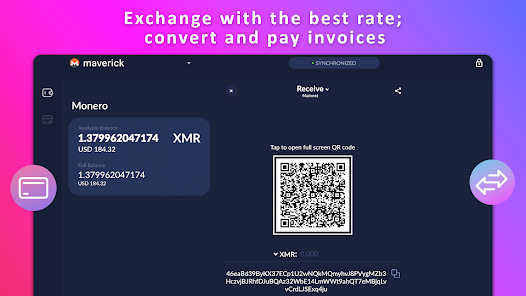
When a wallet supports many coins, each asset brings unique mechanisms and weak points. Monero’s privacy is primarily protocol-native (rings, stealth addresses, confidential amounts) and benefits when the wallet prevents private view key leakage, supports subaddresses, and runs a local or user-selected node. Cake Wallet’s support for background sync and subaddresses, plus an option to select custom nodes and Tor-only mode, is directly aligned with preserving Monero’s guarantees.
Haven (XHV) introduces synthetic assets and pegged instruments on a privacy ledger. Mechanically, those synthetic units inherit the chain’s privacy primitives but add economic links: baskets, mint/burn operations, and off-chain services that could create metadata if not executed carefully. The decision framework for XHV is therefore: evaluate whether the wallet exposes mint/burn counterparties, whether swap routing is decentralized, and whether the synthetic assets’ peg mechanisms create observable patterns. Cake Wallet lists Haven among supported assets; users should treat synthetic instruments as higher operational-risk items relative to native privacy transfers unless the wallet and liquidity routes are fully non-custodial and private.
Network privacy: Tor, I2P, and custom node choices matter
Running your wallet through Tor or I2P is one of the most effective ways to reduce IP-level linking. Cake Wallet’s Tor-only mode and I2P proxy support are therefore major privacy controls. Equally important is the ability to connect to a custom node: if you run your own Monero or Bitcoin node, you remove a large class of node-mediated metadata leaks. For most US users, running a personal node may be infeasible, so choosing a trusted remote node or routing through Tor becomes critical.
However, Tor/I2P is not a panacea. Time-of-use correlation and endpoint compromises can still leak identity. For example, if you always access exchanges at the same times, or if your device reveals identifying information like location services, the anonymity set shrinks. A wallet that offers Tor but pairs it with telemetry or cloud backup would be contradictory; Cake Wallet’s zero-telemetry policy aligns the network privacy features with data-minimization practices.
Device-level security and hardware integration: reducing the human factor
Strong device-level encryption (Secure Enclave on iOS, TPM on Android) and short PIN/biometric gating improve practical security by making seed extraction and casual theft harder. Integrating with hardware wallets (Ledger, air-gapped Cupcake) further reduces key exposure by keeping signing isolated. But hardware integration also comes with usability costs and failure modes: lost devices, forgotten PINs, incompatible firmware, or poor recovery practices can permanently lock access to funds.
Operationally, treat device-level protections as necessary but not sufficient. Backups of seed phrases must be done securely and carefully; seed exposure is still the most common single-point failure. Wallets that are non-custodial and open-source, like Cake Wallet, give you control—but control means responsibility.
Decision framework: three heuristics to choose and use a privacy wallet
1) Default-minimize leaks: Prefer wallets that default to private-friendly settings—Tor-only mode available, mandatory shielding where applicable (ZEC), and no telemetry. Defaults matter because users often accept the path of least resistance.
2) Reduce external trust surfaces: Favor wallets that enable non-custodial swaps (decentralized routing such as NEAR Intents), custom nodes, and hardware wallet integrations. Each external counterparty you add increases the number of entities that can correlate your activity.
3) Plan for failure modes: Know the wallet’s migration limitations (for example, ZEC migration from Zashi requires manual transfers), recovery steps, and backup requirements before moving significant funds. Operational errors during migrations are when privacy lapses are most likely to happen.
If you want to explore a wallet that combines those features—strong defaults, Tor/I2P support, zero telemetry, multi-asset swaps, and hardware integration—you can find relevant information and downloads here.
Where these systems break: realistic limitations and adversarial scenarios
Even the best-configured wallets face several realistic limitations. First, network-level correlation: an adversary monitoring both the network gateway and a destination exchange can correlate timing and volume to deanonymize users. Second, economic fingerprinting: large or unusual transactions can stand out and attract analysis even if the on-chain amounts are obscured. Third, social-engineering and device compromise: malware that harvests seed phrases or screenshots is by far the fastest route to losing privacy and funds.
Specifically for multi-asset wallets, interoperability hazards matter. Instant swaps improve convenience but involve routing across liquidity providers. Decentralized routing (NEAR Intents is an example) reduces reliance on a single intermediary, but it still exposes trade metadata to selected market makers. If an adversary controls several market makers, they can reconstruct swap chains. Therefore, users who value maximal plausible deniability should balance convenience swaps with occasional manual, non-custodial on-chain strategies.
Practical takeaways and what to watch next
For privacy-conscious users in the US: run wallets with Tor or I2P where possible, avoid default public nodes, prefer wallets with no telemetry and clear non-custodial architectures, and integrate a hardware signer if you plan long-term holdings. Treat synthetic assets on privacy chains like Haven with extra caution—understand minting and burning mechanics and the counterparties involved. Finally, be mindful of migration edge-cases (for example, ZEC from Zashi) and test small transfers before moving significant balances.
Signals to monitor in the near term: adoption of transaction-level mixing extensions (e.g., MWEB on Litecoin), wider availability of decentralized swap-routing protocols, and changes in node-level telemetry norms. Each of these trends will change the calculus of privacy vs. convenience and will determine whether multi-currency wallets can keep strong privacy defaults without sacrificing usability.
FAQ
Q: Is holding Haven (XHV) or Monero (XMR) illegal in the US?
A: Holding privacy coins is not per se illegal in the United States. Regulations focus on use and reporting obligations, not on mere possession. However, using privacy coins in connection with illicit activity can attract legal scrutiny. Operationally, keep clear records where appropriate for tax compliance, and consult legal counsel if your use case is complex or high value.
Q: Can a wallet’s Tor mode fully hide my IP?
A: Tor mode masks your IP from the nodes you connect to, but it does not eliminate all correlation risks. Endpoint compromises, timing analysis, or complementary data sources (exchange accounts, web trackers) can still link activity. Tor is a strong layer but must be paired with careful compartmentalization of accounts and device hygiene.
Q: If a wallet is open-source, can I assume it’s secure?
A: Open-source code allows auditors to inspect the software, which is a major benefit, but it does not guarantee correct deployment, secure defaults, or that users will configure it safely. Look for active community audits, clear documentation on privacy defaults, and features like mandatory shielding or zero-telemetry that reduce accidental leaks.
Q: Should I use built-in swaps for routine privacy transactions?
A: Built-in swaps increase convenience and can reduce risky exposure to centralized exchanges, especially if they use decentralized routing. But they also introduce additional counterparties and potential metadata leakage. For routine small transactions, built-in swaps are often fine; for high-value or highly sensitive transfers, consider splitting operations, using custom nodes, or performing manual non-custodial swaps.